
The challenge with proof-of-concepts
To understand how AI could be beneficial, many organisations are undertaking a programme of AI proof-of-concepts (PoCs). They’re seeking to demonstrate how such genuinely phenomenal tools could benefit them. I fear this approach is mistaken.
On their own a portfolio of PoCs does not validate whether they’d sufficiently address a prioritised set of business needs. Neither do PoCs validate whether the capability can be integrated and scaled in the field, without duplication or being cost prohibitive.
At best such PoCs are little more than technical demonstrations of a capability. At worst they create distraction, sunk costs and delay.
Introduce discipline
I believe we first need to put technology out of our mind. Instead we need to focus on the problems of customers, colleagues and the organisation. Identify the need before potentially overspending on an AI solution that may go nowhere.
Once there’s common alignment and prioritisation of the problem to be solved, we then need to canvas for possible solutions. Such solutions may not be technological; a solution could be related to purpose, people or process. I often ask whether a problem can be solved without touching one line of code.
Whatever the potential solution, discipline is needed to ensure its given the oxygen (e.g. funding) only if it shows demonstratable promise to sustainably solve the prioritised problem. This represents proof-of-value.
Truthfully, something like only 1 in 10 will graduate from proof-of-concept to become proof-of-value. This is the nature of discovering the needle in the haystack of organisational complexity.
What kind of value?
When assessing a solution, there are a number of frameworks for value. Here’s a couple.
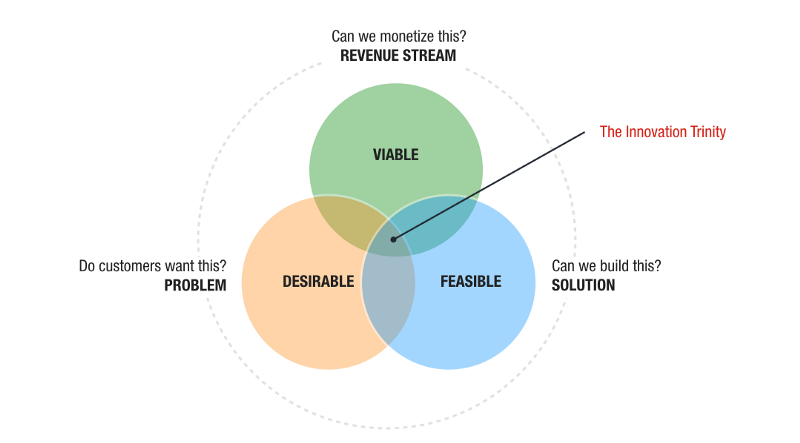
Consider David Kelley’s design thinking framework Desirability, Feasibility, Viability. It checks whether users actually want or need it (desirable), whether we can actually build it (feasible), and whether our business should do it (viable).
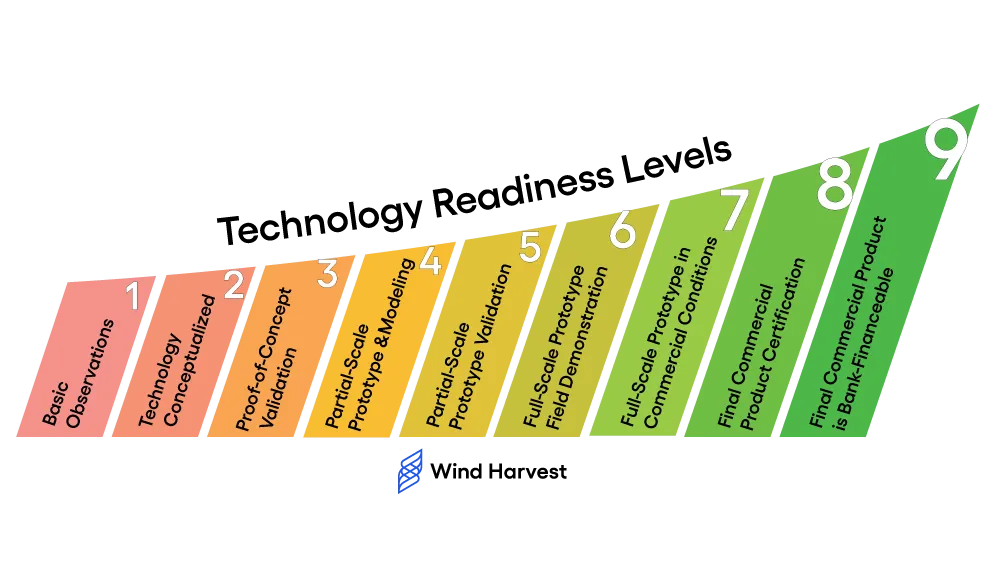
Another example is Technology Readiness Levels, which help determine which solutions are little more than concepts, and which actually show value in the field and are not financially exorbitant.
Conclusion
Many organisations are keen to see value from AI and automation. However, they often take a backward approach of expending talent, capital and time to see what proof-of-concepts stick to the wall. This will likely lead to PoC fatigue, frustration and deepen operational messiness.
Rather than take this solution-first approach, organisations should take a targeted outcome-focused approach. This starts with agreement on the problem to be addressed. Then organisations should institute a discipline of evaluating which solutions are proven to show sustainable value.
Underpin the outcome-focused approach with techniques like hypothesis-driven development and Changeban.
So it’s not so much AI adoption. It’s more outcome-first adoption, which may be achieved with some AI solution.