An Approach to Organisation Change

When working with organisations and clients, this is my reasoning and a suggested approach for examining where and how organisational change should occur.

For the sake of brevity, I won’t dive into detail here. Neither am I suggesting this a one-size-fits-all approach; this is a generic approach that should be customised to the client.

  1. In order for an organisation to compete it needs to establish (or reaffirm) a clear market differentiator that appeals to their customers/clients.
  2. The market is changing rapidly. There’s plenty of emerging threats and opportunities, some are known, some are unknown(able).
  3. The organisation needs to identify the cash cow operations & services that need to be maintained and improved; these drive revenue. This creates one side of what’s termed the Ambidextrous Organisation.
  4. They also need to retire operations & services that no longer drive revenue or are no longer a strategic fit.
  5. Critically the organisation needs to seek new operations & services for new or existing customers/clients. This creates the other side of the ambidextrous organisation. In reality, only a few ideas are credible to scale to become the new cash cows.
  6. Points 3, 4 & 5 should establish a continuous balanced flow of initiatives. This enables the organisation to continuously sense & respond to ensure ongoing market fitness. This creates a Lean Enterprise
  7. Especially for Point 5, since there’s a huge amount of uncertainty, the ways of working, organisational structure, success criteria and leadership style is different from what’s needed for Point 3.
  8. To seek new viable operations and services, the organisation needs to be especially outcome driven, with flexible ways of working, an experimental approach supported by leaders, close co-discovery with stakeholders, close collaboration with customers/clients, where potentially many strategies and solutions are vetted.
  9. This ability for the organisation to sense and respond is in keeping with The Agile Business Consortium’s definition of Business Agility.
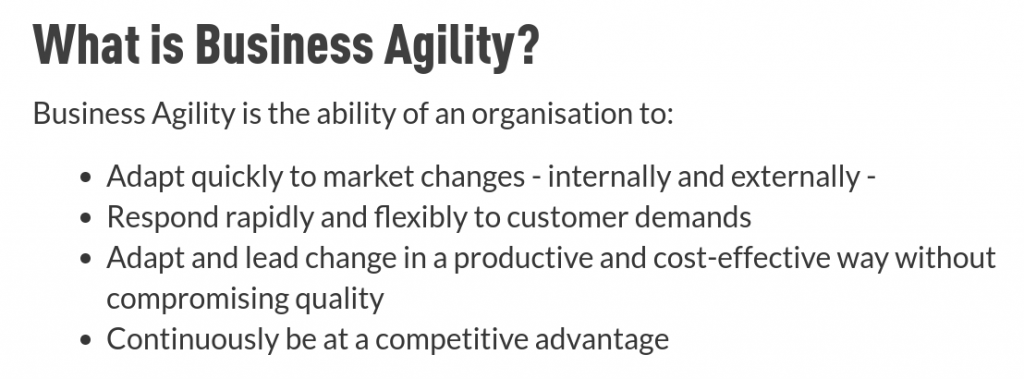
Agile Business Consortium’s definition of Business Agility

Where to start

To develop and carryout changes of such significance and depth requires the direct involvement of the leadership team. The following slides provides a high-level view of what such an engagement is likely to cover.

Further Reading

Thanks to Luca Minudel for helping me strengthen this article.
Starting an Engagement

In this article I’ll explain my current approach to starting an engagement or initiative with the leadership team.

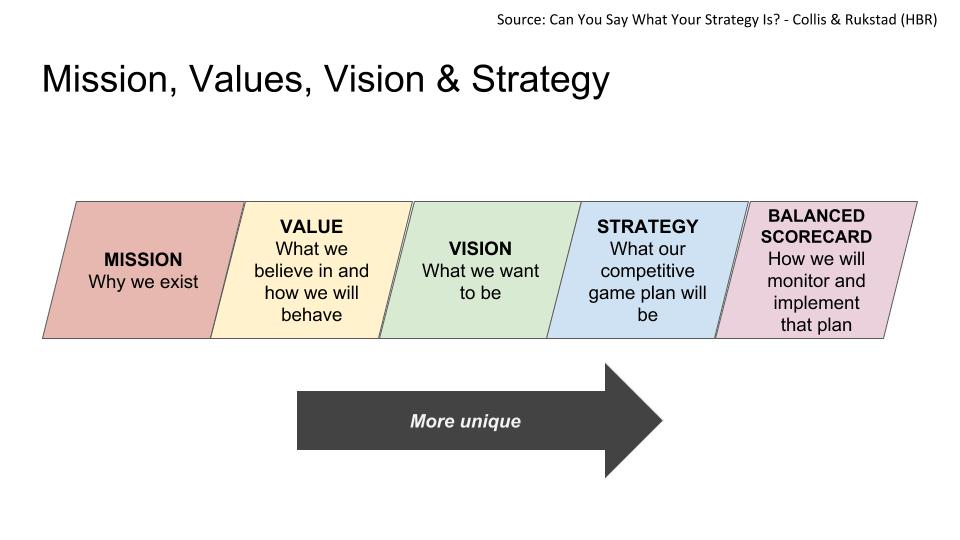
This approach will ensure the initiative gets off and continues on the right footing. It’s been inspired by Collis’ and Rukstad’s approach to articulating a strategy.

Let’s start with establishing and agreeing the initiative’s intent, what outcomes it’s trying to achieve, and the rules of engagement. Created collectively during a kick-off workshop, each of the following should have a statement written in a few clear sentences; the balanced scorecard will need something a little more elaborate.

Mission

Why the initiative exists. What’s the underlying motivation of the initiative; what’s its contribution to the wider organisation and whom it’s ultimately serving.

Values

Establish what the engagement team will believe in, and how it will behave. This team is a partnership of the key stakeholders/leaders and the consultants/coaches.

The values govern how the team behave (“doing the right thing”), not necessarily what the team should do (“the right thing to do”).

Vision

What we want the initiative to deliver. It could be an indeterminate future goal.

Strategy

What’s our game plan. Identify a number of coherent approaches that the team have reasonable confidence in. From these create an ordered backlog.

Ensure they’re SMART objectives. Know that certain approaches may fail, so ensure a plurality of strategies, and a flexible mindset.

To ensure understanding and alignment, use tools such as Karl Scotland’s Backbriefing A3.

Balanced Scorecard

Monitor and judge which approaches are working against success criteria.

To help with visibility and alignment, ensure the statements and balanced scorecard are shared across the organisation and with the relevant suppliers & partners.

Throughout the engagement judge buy-in and motivation, especially their appetite for uncertainty and the need to potentially change some established expectations. Establish how much genuine leadership commitment exists, especially when it comes to making some tough trade-offs.

The kick-off should be the start of an ongoing review to see if the initiative is on track; to check whether to continue with the current set of approaches or pivot with another set.

Importantly, if despite best efforts, the initiative isn’t providing value, exercise the option to end it early. There’s no point spending time and money flogging a dead horse.

I’m available if you’d like someone experienced to facilitate this as part of an engagement’s kick-off and to periodically review progress.

References