Time to stop talking about Transformation and Agile?

Economic and business uncertainty means many organisations are retrenching and protecting their operations and market offerings. Cost-cutting, head-count freezes and workforce reductions are likely levers organisations are focusing upon. This indelibly marks the climate within organisations, the concerns of leaders and anxieties of their staff.

There’s a lessening appetite for transformational work and once trending approaches such as Agile are no longer top of mind.

So, as change agents working with colleagues and clients, we need to be very careful using terms such as Transformation and Agile. Directly focusing on such activities and approaches are likely to have little currency and draw little attention.

Instead, when consulting and supporting colleagues and clients, try to pick up on their language and empathise with their position. In confidence, try to help them articulate their concerns.

Use techniques such as Agendashift’s 15-minute FOTO which helps them shift from obstacles to outcomes.

I’m not saying dismiss the values and principles of agility. I’m suggesting having these at the back of your mind, and play them into your client’s or colleague’s situation without hitting them over the head with Agile and Transformation. They’re likely already bruised by ill-fitting adoption of such approaches and initiatives.

Work with them to run safe-to-learn change experiments. Such experiments are likely to focus on protecting value with less – less funding and sadly potentially less colleagues.

So, unless they use them, stop starting conversations with terms such as Transformation and Agile. Instead, use their language, recognise their change anxiety, and co-discover approaches which enable their organisations to respond to a rapidly changing world.
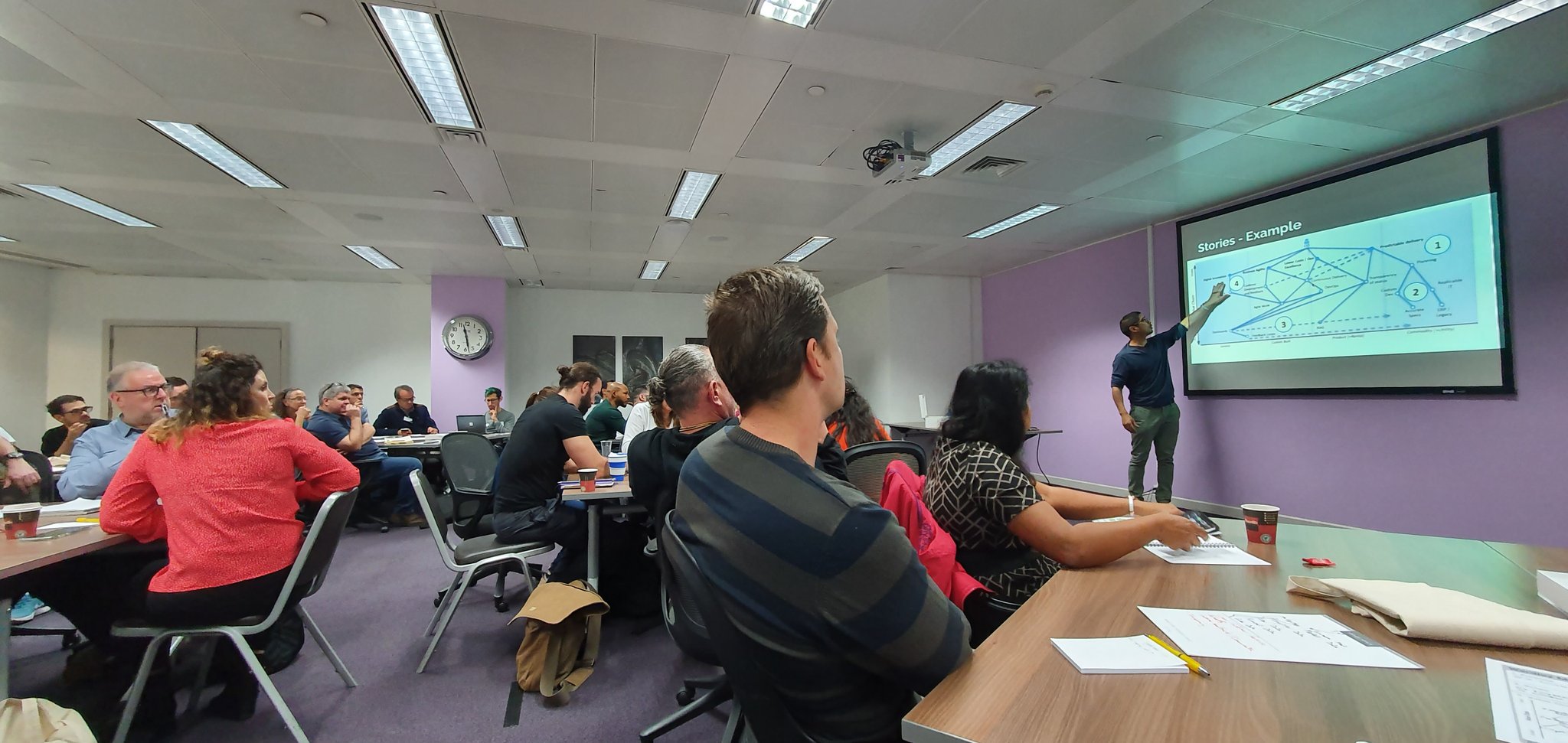
Workshop: Wardley Mapping

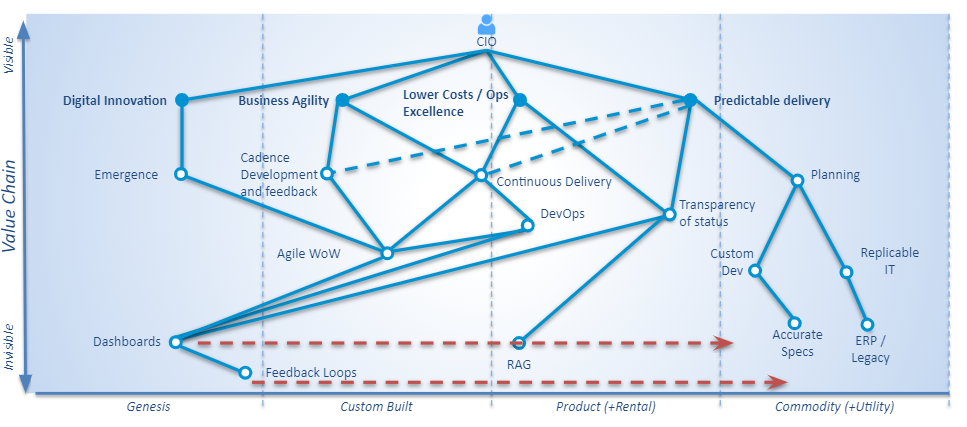
This workshop introduces Wardley Mapping as a technique to understand the chain of components an organisation needs to serve user needs. It creates situational awareness by mapping the maturity of each component, and the visibility of the component to the user. It allowing organisations to better strategise and improve their effectiveness and competitiveness.

The workshop can be delivered in 60 to 120 minutes. It’s team-based and can be run for any number of teams.

Slidedeck

photos from workshops

Thank you

Thank you to Philippe Guenet for working with me in developing the workshop.

Wardley Mapping is conceived by and is kindly shared by Simon Wardley.

Implementing Governance talk

Implementing Governance

Implement means to execute. Governance means to rule and control. This suggests implementing governance is a top-down deterministic approach to management. Such approaches are no longer fit-for-purpose.

Leaders and delivery teams should co-create approaches to ensure alignment and synchronisation. This talk is about collaborative approaches which support teams to deliver value.

Slidedeck

Watch a previous presentation

Watch the 45-minute video of this talk presented at the 2020 Aginext conference.

Business Agility

Increasing your organisation’s competitiveness

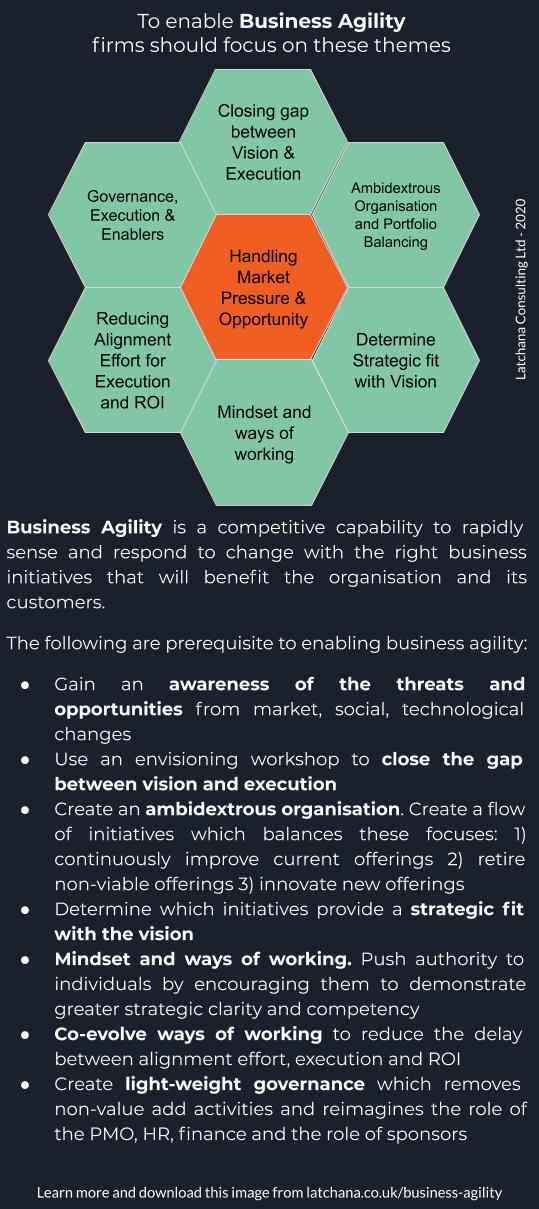
Business Agility is a competitive capability to rapidly sense and respond to change with the right business initiatives that will benefit the organisation and its customers.

The following are prerequisite to enabling business agility:

  • Gain an awareness of the threats and opportunities from market, social, technological changes
  • Use the Envisioning workshop to close the gap between vision and execution.
  • Create an ambidextrous organisation. Create a flow of initiatives which balances these focuses: 1) continuously improve current offerings 2) retire non-viable offerings 3) innovate new offerings
  • Determine which initiatives provide a strategic fit with the vision
  • Mindset and ways of working. Push authority to individuals by encouraging them to demonstrate greater strategic clarity and competency
  • Co-evolve ways of working to reduce the delay between alignment effort, execution and ROI
  • Create light-weight governance which removes non-value add activities and reimagines the role of the PMO, HR, finance and the role of sponsors

Resource to download, print and share

Presentation slides

Contact me (dean@latchana.co.uk) if you’d like this presented in your organisation or business community.

An Approach to Organisation Change

When working with organisations and clients, this is my reasoning and a suggested approach for examining where and how organisational change should occur.

For the sake of brevity, I won’t dive into detail here. Neither am I suggesting this a one-size-fits-all approach; this is a generic approach that should be customised to the client.

  1. In order for an organisation to compete it needs to establish (or reaffirm) a clear market differentiator that appeals to their customers/clients.
  2. The market is changing rapidly. There’s plenty of emerging threats and opportunities, some are known, some are unknown(able).
  3. The organisation needs to identify the cash cow operations & services that need to be maintained and improved; these drive revenue. This creates one side of what’s termed the Ambidextrous Organisation.
  4. They also need to retire operations & services that no longer drive revenue or are no longer a strategic fit.
  5. Critically the organisation needs to seek new operations & services for new or existing customers/clients. This creates the other side of the ambidextrous organisation. In reality, only a few ideas are credible to scale to become the new cash cows.
  6. Points 3, 4 & 5 should establish a continuous balanced flow of initiatives. This enables the organisation to continuously sense & respond to ensure ongoing market fitness. This creates a Lean Enterprise
  7. Especially for Point 5, since there’s a huge amount of uncertainty, the ways of working, organisational structure, success criteria and leadership style is different from what’s needed for Point 3.
  8. To seek new viable operations and services, the organisation needs to be especially outcome driven, with flexible ways of working, an experimental approach supported by leaders, close co-discovery with stakeholders, close collaboration with customers/clients, where potentially many strategies and solutions are vetted.
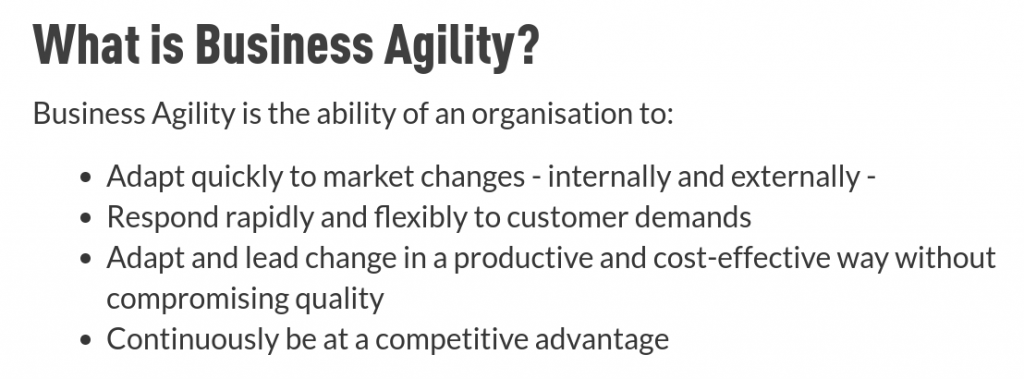
  9. This ability for the organisation to sense and respond is in keeping with The Agile Business Consortium’s definition of Business Agility.
Agile Business Consortium’s definition of Business Agility

Where to start

To develop and carryout changes of such significance and depth requires the direct involvement of the leadership team. The following slides provides a high-level view of what such an engagement is likely to cover.

Further Reading

Thanks to Luca Minudel for helping me strengthen this article.