MIT’s recent The GenAI Divide: State of AI in Business 2025 report states that “The 95% failure rate for enterprise AI solutions represents the clearest manifestation of the GenAI Divide”. It says this is caused not by the quality of the tools, but rather the “learning gap” for both the tool and organisation, and flaws in enterprise integration.
In an attempt to gain efficiencies and innovate, I’ve seen organisations excited to roll out GenAI tools. As the MIT report indicates, they should first fundamentally understanding the systems and people such initiatives are purportedly trying to support.
I believe they ought to do this by first asking leaders to align on the most critical customer & colleagues challenge to overcome, and the business outcomes that are most pressing. Those leaders should then learn how systems, processes and incentives may need to change. Such changes should be explored and measured by trialing different approaches, some of which may utilise technologies such as GenAI.
Such a strategy aligns to the principle of People, Process, Tooling, in That Order. This is one of the Better Value Sooner Safer Happier principles for business agility.
One reason to start with People is that any technological system will not have the tacit knowledge that exists within and between individuals (thank you John Abram for bringing this to my attention). Tacit knowledge is the practical “know-how” that’s difficult to articulate and rarely written-down. It’s often expressed in an unanticipated manner, and only at the time of application.
For example, consider an experienced salesperson teaching a junior employee. During a sales meeting, the latter will learn through observation, imitation, studying body language, and through anecdotal storytelling. These are too ineffable to be derived through studying employee handbooks, process documentation or through GenAI systems.
So, without adopting this outcome-first and customer & colleague centric approach, I fear many GenAI-led initiatives will be fundamentally flawed. They’ll add to the sorry litany of failed technology-focused transformations. The MIT report bares this out.
So, say no to GenAI solution-first thinking. Instead align on the problem to be solved and give colleagues the right freedoms to improve how they serve their customers, which may utilise technologies such as GenAI.
Don’t create pain by rolling out GenAI tooling based on poorly tested assumptions and expect colleagues to use it. Many will suffer in silence, and use the tool begrudgingly. Ironically it’ll likely add to inefficiencies, not reduce them.
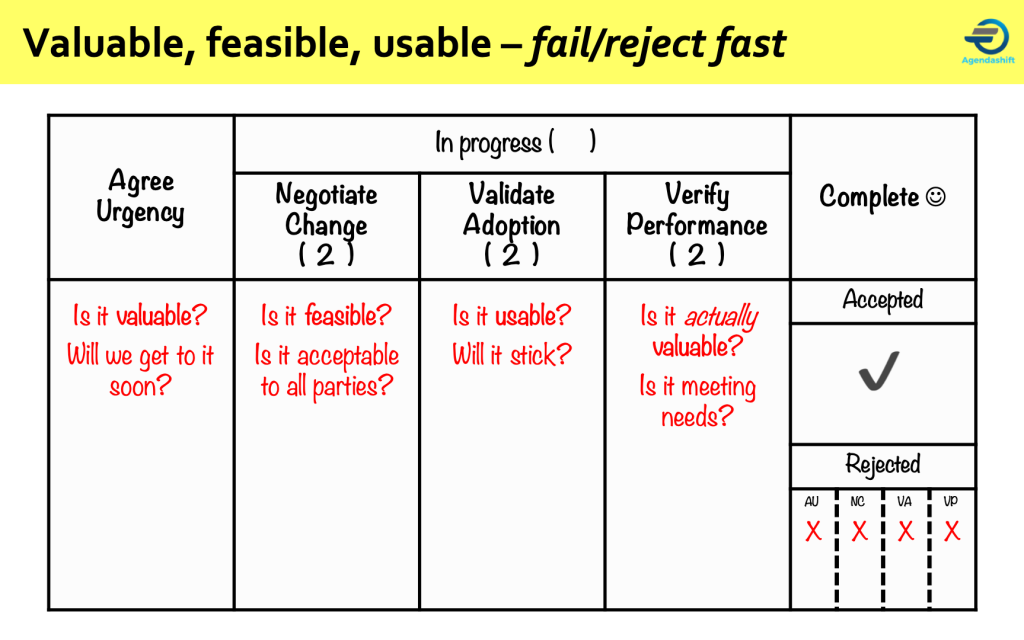
Finally, consider employing visual tools such as Agendashift’s Changeban to place a strong emphasis on knowledge discovery and organisational learning. Collectively learn and measure, rather than assuming then integrating!
Contact me if you’d like to learn more.