In this talk learn how the Project/Programme Portfolio Office can support their business in recognising and handling uncertainty. Learn how the PMO can coordinate the balance and flow of initiatives through each stage of the delivery lifecycle, through to delivery of value.
Category: change management
Implementing Governance talk
Implementing Governance
Implement means to execute. Governance means to rule and control. This suggests implementing governance is a top-down deterministic approach to management. Such approaches are no longer fit-for-purpose.
Leaders and delivery teams should co-create approaches to ensure alignment and synchronisation. This talk is about collaborative approaches which support teams to deliver value.
Slidedeck
Watch a previous presentation
Watch the 45-minute video of this talk presented at the 2020 Aginext conference.
Business Agility
Increasing your organisation’s competitiveness
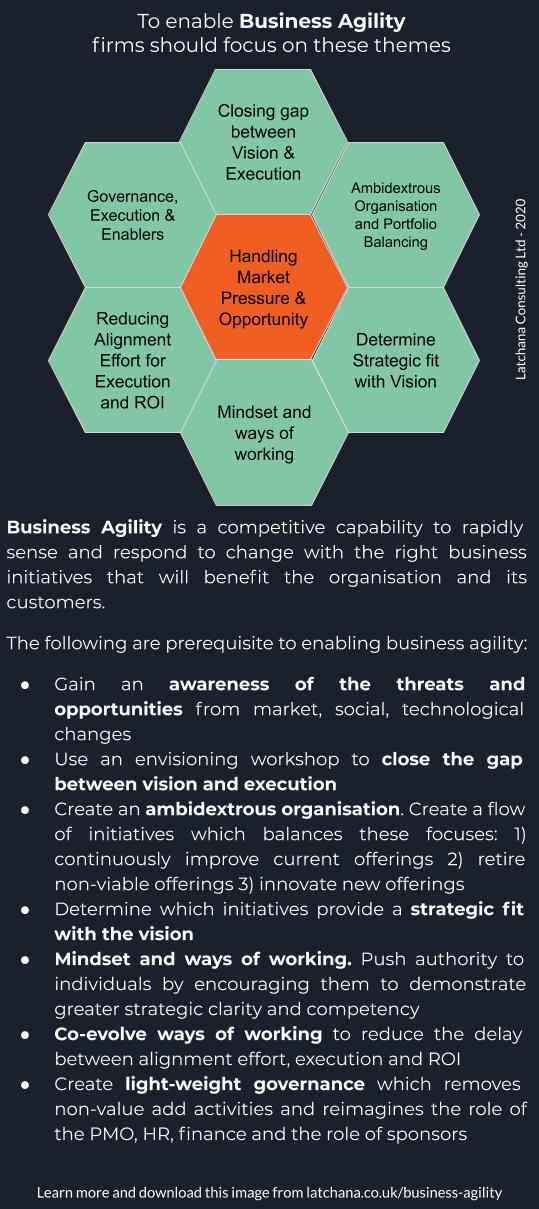
Business Agility is a competitive capability to rapidly sense and respond to change with the right business initiatives that will benefit the organisation and its customers.
The following are prerequisite to enabling business agility:
- Gain an awareness of the threats and opportunities from market, social, technological changes
- Use the Envisioning workshop to close the gap between vision and execution.
- Create an ambidextrous organisation. Create a flow of initiatives which balances these focuses: 1) continuously improve current offerings 2) retire non-viable offerings 3) innovate new offerings
- Determine which initiatives provide a strategic fit with the vision
- Mindset and ways of working. Push authority to individuals by encouraging them to demonstrate greater strategic clarity and competency
- Co-evolve ways of working to reduce the delay between alignment effort, execution and ROI
- Create light-weight governance which removes non-value add activities and reimagines the role of the PMO, HR, finance and the role of sponsors
Resource to download, print and share

Presentation slides
Contact me (dean@latchana.co.uk) if you’d like this presented in your organisation or business community.
Prerequisites for change – The 4As
For an individual to develop the desire and willingness for a difficult change, I’ve found it helpful to consider these four stages as prerequisites: Acknowledge, Awareness, Appetite and Action.
Together I’ve called them The 4As of Change.
Stage 1: Acknowledge impact of issue, personally
The individual needs to acknowledge how an issue is impacting them personally. They need to grasp the implications of how the issue is affecting their perception amongst their peers, how it’s hindering their goals and impacting the wider organisation.
This step ensures a proposed change starts with why it’s personally necessary.
For example, suppose someone is managing a globally distributed team. The team is consistently delayed with their deliverables. For the manager to truly appreciate the issue and have a desire to address it, the manager needs to acknowledge how this issue is impacting them personally.
Stage 2: Have awareness of a solution
The individual needs to have an awareness that solutions may exist.
For example, a manager would need to be aware that co-locating the team in one location, to enable face-to-face communication, could reduce misunderstanding and delays amongst the team.
Stage 3: Develop an appetite for the change
They then need to develop a sufficient appetite to advocate for the change and its solution.
Supporting the change may be challenging because it may involve a personal, then a public, admission that a change is needed.
An individual needs to become an advocate to gain the backing of others who may express varying degrees of support. Trials may need to be carried out to validate and convince others the solution is right.
Using the previous example, although a manager may believe co-locating could be right, they may need to gain enough backing to carry out a trial. Others may be sceptical if, for example, it means other managers would lose influence over individuals moving from their location; or individuals in the team may not be able to accommodate the change.
Through trials and discussions, the solution may need many alterations. If protracted it’s likely to reduce appetite and possibly prevent the change from happening.
If the manager has maintained sufficient appetite
Stage 4: Take action to trial the change
Now, finally, the individual is ready for action.
This is the final stage where success criteria are affirmed collectively, and the change is planned, executed and then reviewed collectively.
Coaching or line managing others through the stages
If you are a coach or line manager, the following considerations may support others progress through each of the prerequisite stages of change.
- As a coach or line manager, be aware of the particular stage an individual is at. Provide support that’s contextual to that stage.
- Know that the way to think differently is to act differently. When you encourage others to act differently, they’ll start to see and experience the world differently, impacting their mindset as a result.
- Since change can be challenging, suggest breaking the change into small rapid experiments. This can bring much-needed evidence and insights, which can be particularly powerful when assessing a change’s appropriateness and when developing an appetite for the change.
- Facts and data are often not as convincing as a compelling story, so use stories where such a change has been previously successful. Consider asking someone external to share a story of such a change from their experience.
- Gain peer-level support for the change. Change is more likely when others independently state its
benefits, or show keenness for the change. - Consider the BJ Fogg’s maxims:
- Help people do what they already want to do
- Help people feel successful